
ASO vs Fully-Insured
Which one fits your company?
Understanding the fee difference between funding models is a critical part of structuring your plan. On a fully insured plan paying $100,000 in premium, the insurer typically reserves $80,000 for claims and retains $20,000 for expenses, risk, and profit. Under ASO (Administrative Services Only), you fund your own claims and pay a significantly lower admin fee. Please note that the actual fee depends on the insurer and the number of lives insured.
How the two models compare
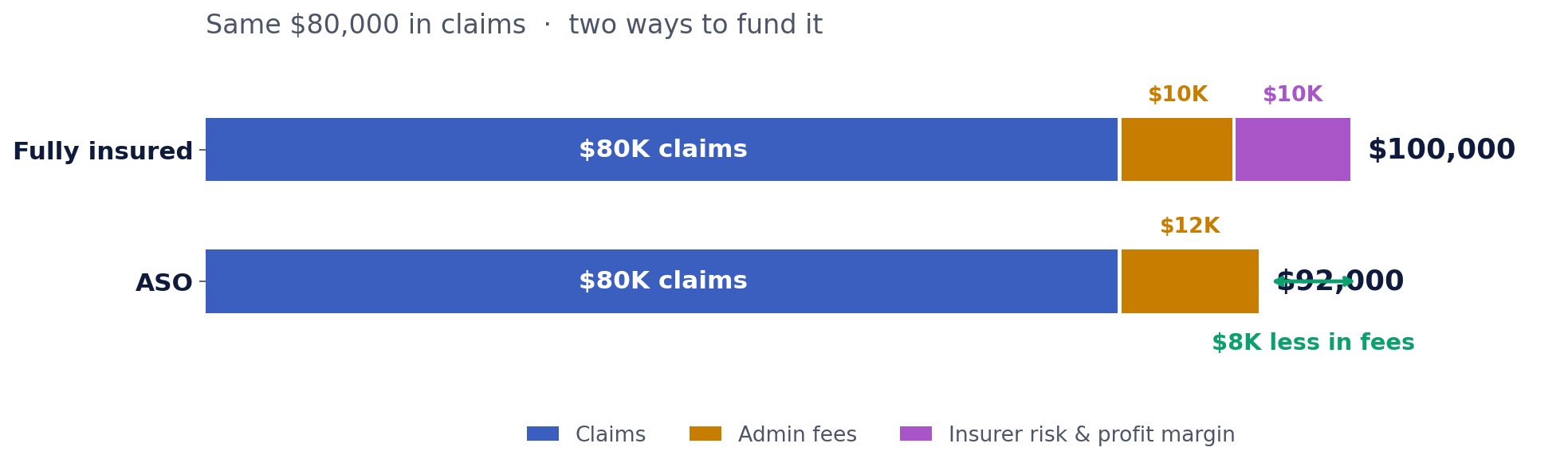
The chart above assumes $80,000 in claims under both models. In our example, the fully insured plan costs $100,000 in total while the ASO plan costs $92,000, a fee saving of $8,000 or a 40% reduction in fees.
Under a Fully-insured plan, you pay a fixed premium regardless of how claims fluctuate throughout the year, and rates are adjusted once a year at renewal based on the claims experience.
Under ASO, you fund actual claims in addition to the fee charged by the insurer. There are several ways to structure an ASO, but in all cases, if there's a surplus balance you may qualify for a refund, and conversely, a lump sum payment if the balance goes into a deficit.
Where to start
Dental is the logical starting point because annual maximums cap your liability. There should be several years of claims history that also show minimal fluctuations.
Extended health carries risks like high-cost drugs or travel claims, so the catastrophic elements should remain fully insured (e.g., pooling claims above $10,000).
Is ASO right for you?
Not always. Small groups lack the stability to make ASO fee savings reliable, as a single high-claims year can wipe out years of accumulated margin. You need a minimum of three years of steady claims and enough members to spread the risk.